
 Shqip
Shqip لالعربية
 Polski
 رسی
رسی Deutsch
 Русский
 Français
 한국어
한국어 Nederlands
 Čeština
 Bahasa Melayu
 Português
 日本語
日本語 Svenska
 Kiswahili
 ไทย
ไทย Türkçe
 Українська
 Español
 Italiano
 हिन्दी
 Bahasa Indonesia
Across the United States, a quiet transformation is taking place in how people approach housing, remote work, and emergency shelter. For generations, the American dream of owning a home has been tethered to traditional construction—costly, time-consuming, and increasingly out of reach for millions. But a new category of building technology is rewriting those rules, offering a solution that is faster, more affordable, and surprisingly sophisticated.
At the forefront of this movement is SXKON, a manufacturer that has spent over two decades refining the art of prefabricated housing. Its expandable container house line—featuring 20-foot and 40-foot retractable units—is gaining traction among U.S. homeowners, contractors, disaster response agencies, and hospitality developers alike. Designed to ship compactly and deploy rapidly, these steel-framed structures are proving that modular living can be both practical and elegant.
This article examines the growing appeal of expandable container homes in the American market, the technology that makes them work, and why SXKON is emerging as a brand worth watching. The decoration materials for the expansion rooms, including the floor, doors and windows, bathrooms, insulation layer, fireproof materials, and household appliances, can all be customized according to your needs.
1. The Housing Crunch That’s Pushing America Toward Modular Alternatives
The numbers tell a sobering story. According to Fortune Business Insights, the global container homes market was valued at USD 68.24 billion in 2025 and is projected to reach USD 128.3 billion by 2034, with North America holding a dominant 37.1 percent market share [12†L9-L11]. The U.S. market alone is estimated to reach USD 42.67 billion by 2032, driven by persistent demand for innovative architectural solutions [12†L12-L14].
But market growth is only half the picture. The deeper driver is a housing affordability crisis that shows no signs of easing. Nearly three-quarters of Americans identify the lack of affordable housing as a major issue in their communities [14†L7-L8]. Traditional home construction costs have soared, with single-family homes often ranging from USD 350,000 to USD 800,000—a price tag that has priced out an entire generation of prospective buyers [17†L54-L55].
Against this backdrop, foldable and expandable container homes have emerged as a compelling alternative. Industry analysis from Capsule House Manufacturer indicates that foldable housing containers can cost up to 70 percent less than conventional construction, with rapid deployment times measured in days rather than months [14†L15-L16]. For developers and municipalities seeking to stretch limited budgets while delivering livable spaces quickly, the value proposition is hard to ignore.
2. SXKON’s 20-Foot and 40-Foot Retractable Container Rooms: A Closer Look
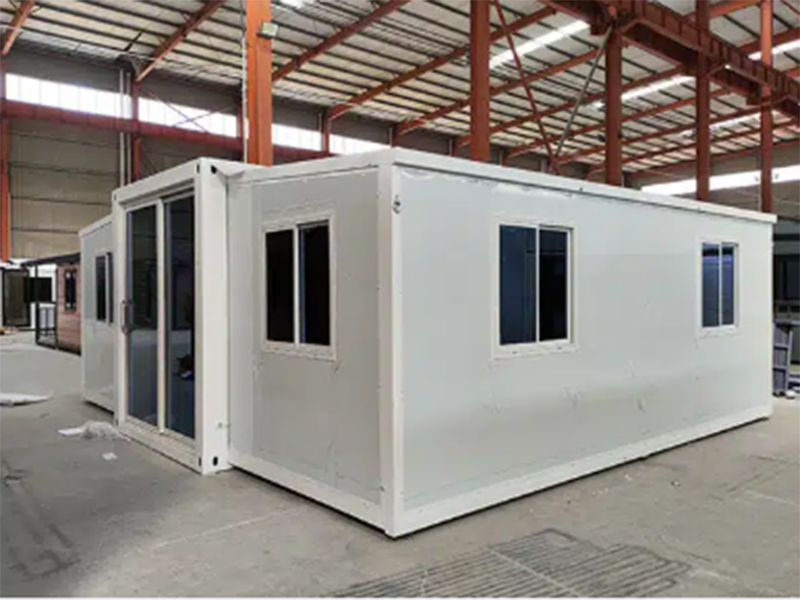
SXKON’s approach to expandable housing centers on two flagship models: the 20-foot retractable container room and its larger 40-foot counterpart. Both units are manufactured in Weifang City, Shandong Province, where SXKON has been producing container-based structures since 2003. The company has already secured supply contracts with buyers in more than 30 countries, including Australia, Canada, and the European Union [10†L21-L24].
The 20-Foot Model
The 20-foot unit is engineered for versatility. When folded for transport, it occupies dimensions of L5900×W2200×H2480 millimeters. Once on-site and expanded via a patented Z-fold mechanism, it transforms into a spacious L5900×W6300×H2480 millimeter layout, delivering approximately 37 square meters of floor space—comparable to a small apartment or a generously sized office [9†L19-L21]. Setup takes less than two hours, reducing labor costs and construction time by up to 80 percent compared to traditional buildings [9†L21-L23].
Construction materials are equally impressive. The unit is built from military-grade Corten steel (ASTM A588 certified), a weathering steel known for its exceptional corrosion resistance and structural integrity. SXKON claims a lifespan exceeding 50 years for the core structure, with the ability to withstand wind speeds of 150 kilometers per hour and seismic activity up to magnitude 8.0 [9†L24-L26]. These specifications position the unit as a viable option not just for temporary use but for long-term habitation.
The 40-Foot Model
For those requiring more generous living or working space, the 40-foot retractable container room delivers approximately 320 square feet of usable space in its standard configuration, expanding to up to 700 square feet when fully deployed [10†L14-L18]. Remarkably, installation can be completed in as little as 10 minutes using a simple foundation of concrete blocks, making it one of the fastest-deploying expandable units on the market [10†L18-L20].
Like its smaller sibling, the 40-foot model is constructed from high-quality Corten steel and features pre-installed solar panel compatibility along with water management systems to enhance energy efficiency [10†L26-L36]. Customization options include layouts ranging from one to four bedrooms, with pre-fitted plumbing and electrical systems that meet international certification standards [10†L37-L39].
Thermal Performance and Compliance
One of the perennial concerns about container-based housing is thermal regulation. SXKON addresses this with insulation rated at R-18 to R-22, enabling the units to perform reliably in extreme temperatures ranging from minus 40 degrees Fahrenheit to 120 degrees Fahrenheit [9†L41-L42]. The units also carry ISO 9001, CE, and ANSI/AISC 360-16 certifications, along with an IP55 waterproof rating and Class A fire resistance [9†L40-L42]. For U.S. buyers, these certifications help align the product with local building codes, though as with any modular structure, compliance ultimately depends on jurisdictional zoning and permitting requirements [17†L7-L11].
3. Beyond Housing: Where Expandable Container Houses Are Making an Impact
The versatility of SXKON’s expandable container houses extends well beyond residential applications. In fact, some of the most compelling use cases are emerging in sectors where speed, portability, and cost-effectiveness matter most.
Disaster Response and Emergency Shelter
When hurricanes, wildfires, or floods strike, the clock is the enemy. Traditional rebuilding efforts can take months or even years, leaving displaced populations in temporary shelters that often fall short of adequate living standards. Expandable container houses offer a different model: units that can be pre-positioned in regional warehouses, then deployed within 72 hours to affected areas [9†L37-L39]. Organizations such as Yes Containers note that modular container-based housing can be assembled in a matter of weeks, with costs 50 to 70 percent lower than traditional builds [13†L19-L21]. For government agencies and NGOs operating on tight budgets, this combination of speed and affordability is transformative.
ADUs and Backyard Living
Across the United States, accessory dwelling units (ADUs) have become a popular strategy for adding housing density without extensive new construction. California, Oregon, Washington, and other states have relaxed zoning regulations to encourage ADU development, creating a ready market for compact, pre-fabricated structures. SXKON’s 20-foot retractable container room fits this niche perfectly, offering a fully functional living space—kitchen, bathroom, bedroom, and living area—in a footprint that fits comfortably on most residential lots. For homeowners seeking rental income, multi-generational living arrangements, or simply a dedicated home office, the economics are compelling.
Remote Workspaces and Construction Site Offices
The remote work revolution, which now includes over 22 percent of American employees working from home at least part-time, has created demand for dedicated office spaces that are separate from the main residence [9†L35-L36]. SXKON’s prefab mobile home office model addresses this need directly. Designed with corrosion-resistant steel frames, sealed windows, thermal wall panels, and optional acoustic treatment, the unit can be configured for single-room, meeting-room, or dual-desk layouts. Plug-and-play power systems, solar and battery inputs, HVAC readiness, and smart add-ons—including network cabinets, PoE for cameras, motion sensors, and keypad entry—make it a fully functional workspace that can be deployed on construction sites, campuses, festivals, or any location where a permanent building isn’t practical [8†L19-L29].
Hospitality and Eco-Resorts
The tourism industry is also taking notice. Glamping sites, eco-resorts, and boutique hotels are increasingly turning to container-based accommodations for their minimal environmental impact and design flexibility. A recent project in Texas utilized three 40-foot SXKON retractable container rooms to create a spacious residence with outdoor living areas, demonstrating the design’s adaptability [10†L47-L49]. For seasonal resorts or pop-up hotels, the ability to relocate and reconfigure units as demand fluctuates adds a layer of operational agility that traditional construction cannot match.
4. Technology, Durability, and the Long-Term Investment Case
Prospective buyers naturally ask about longevity. Expandable prefab houses, when properly maintained, typically last 20 to 30 years, with some exceeding 30 years under ideal conditions [19†L4-L6]. SXKON’s use of Corten steel—a material specifically formulated to form a stable rust-like appearance after exposure to weather, eliminating the need for painting and reducing long-term maintenance—extends this lifespan considerably. The company claims a 50-plus-year structural life for its units, supported by its Z-fold mechanical system and reinforced corner castings [9†L24-L25].
From an energy efficiency standpoint, the numbers are equally encouraging. The airtight building envelopes achieved through factory-controlled precision deliver up to 40 percent better thermal performance than traditional homes, with HVAC loads reduced by 30 to 35 percent according to 2023 building performance studies [21†L37-L40]. When equipped with solar-ready roofs, homeowners can save 55 to 60 percent on annual energy costs, and over a 25-year period, these savings translate into the prevention of 80 to 110 metric tons of carbon dioxide emissions [21†L47-L52].
Cost comparisons further strengthen the case. A standard 20-foot container home with full sanitation facilities starts at approximately USD 8,500 [20†L19-L21]. While site preparation, permitting, and customization will add to this baseline, the total investment remains substantially lower than conventional stick-built housing. By contrast, traditional construction can take 9 to 18 months to complete, with labor expenses ranging from USD 52 to USD 68 per square foot compared to USD 28 to USD 42 per square foot for prefab alternatives [21†L29-L31].
5. Regulatory Landscape and What Buyers Need to Know
No discussion of container housing in the United States would be complete without addressing the regulatory environment. Building a container home—whether expandable, collapsible, or fixed—requires navigating zoning laws, building permits, structural inspections, and state-specific codes [17†L7-L11]. The situation is not uniform. Some jurisdictions classify container units as temporary structures with streamlined permitting processes, while others impose the same requirements as traditional site-built homes.
Federal regulations also play a role. Title 24 of the Code of Federal Regulations, Section 3285.502, specifies that support and anchoring systems for expanding rooms must be installed in accordance with designs provided by the home manufacturer or prepared by a registered professional engineer [18†L5-L8]. SXKON addresses this by providing engineering documentation and installation guidance, though buyers are ultimately responsible for confirming placement, utilities, and occupancy rules with local authorities having jurisdiction [8†L36-L39].
For buyers considering an expandable container house, the prudent approach is to engage with local building departments early in the process. Many cities have become more receptive to modular housing as the affordability crisis deepens, and some have established dedicated pathways for ADU and container-home approvals. Working with an architect or contractor experienced in modular construction can streamline the permitting process significantly.
6. Market Outlook: Why Expandable Container Houses Are Here to Stay
The global expandable container home market was valued at USD 787 million in 2024 and is projected to reach USD 1.05 billion by 2031, representing a compound annual growth rate of 4.2 percent [25†L8-L11]. When viewed within the broader container homes market—valued at USD 62.2 billion in 2025 with projected growth to USD 120.5 billion by 2034 at a CAGR of 7.6 percent—the segment’s trajectory is clear: expandable and foldable designs are capturing an increasing share of consumer attention [11†L6-L7].
Several converging trends are fueling this growth. First, the persistent affordability gap in traditional housing has forced buyers to explore alternatives. Second, sustainability concerns—with 67 percent of consumers prioritizing eco-friendly purchases—have elevated the appeal of recycled steel construction and energy-efficient design [9†L33-L34]. Third, the flexibility of expandable units aligns perfectly with modern lifestyles that value mobility, adaptability, and multi-functionality.
SXKON is well-positioned to capitalize on these trends. With over two decades of manufacturing experience, a portfolio of certified products, and an expanding North American distribution network, the brand offers a compelling combination of engineering rigor and practical design. As one industry observer noted, the key differentiators for SXKON include construction costs that are 40 to 60 percent lower than traditional methods, minimal foundation requirements, and the ability to combine multiple units for larger configurations [9†L51-L52].
Conclusion
The American housing market is at an inflection point. Decades of rising costs, constrained supply, and regulatory complexity have created an environment where innovative solutions are not just welcome but necessary. Expandable container houses—exemplified by SXKON’s 20-foot and 40-foot retractable models—offer a practical path forward: durable, energy-efficient, rapidly deployable, and surprisingly livable.
For homeowners seeking an ADU, contractors needing a mobile job-site office, disaster response agencies planning for the next emergency, or developers exploring boutique hospitality projects, the value proposition is compelling. And as building codes continue to evolve in favor of modular construction, the barriers to adoption are likely to diminish further.
In the end, the question may not be whether expandable container houses will become a significant part of the American housing landscape, but how quickly. Judging by current market momentum, the answer appears to be: sooner than many expect.
For more information on SXKON’s expandable container house products, including custom configurations, bulk ordering, and dealer support, visit www.sxkon.com.


