
 Shqip
Shqip لالعربية
 Polski
 رسی
رسی Deutsch
 Русский
 Français
 한국어
한국어 Nederlands
 Čeština
 Bahasa Melayu
 Português
 日本語
日本語 Svenska
 Kiswahili
 ไทย
ไทย Türkçe
 Українська
 Español
 Italiano
 हिन्दी
 Bahasa Indonesia
Double-Wing Expansion Box Review: Performance Comparison of 4 Mainstream Models
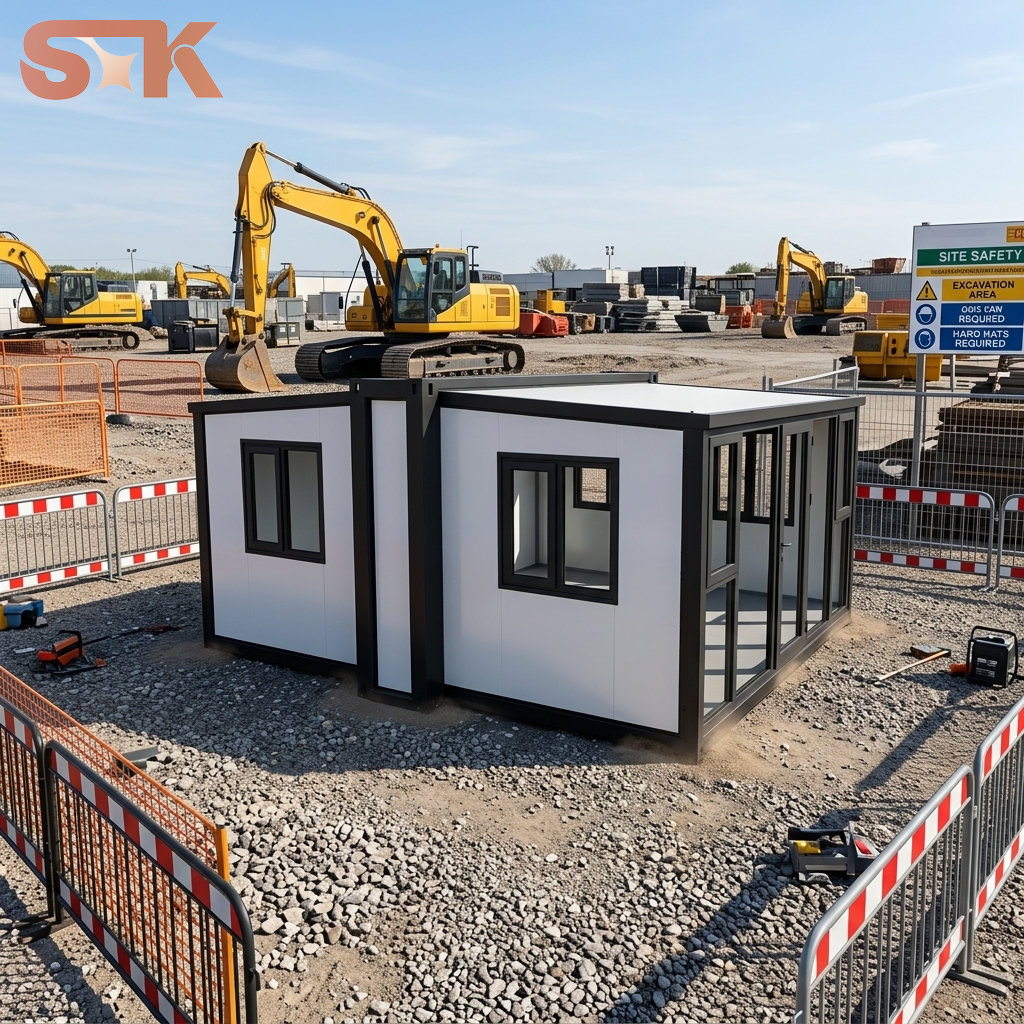
In the fields of modular construction, outdoor temporary offices, emergency accommodation, and camp homestays, double-wing expansion boxes have gradually replaced traditional prefab houses as a mainstream industry solution. Featuring foldable design, expandable space, easy transportation, and fast installation, these modular boxes deliver outstanding practicality. However, the market is flooded with double-wing expansion box products with inconsistent craftsmanship and technical parameters, making it difficult for buyers to identify genuine performance differences merely through official product descriptions.
To solve the product selection dilemma for users, we conducted comprehensive on-site tests on four mainstream double-wing expansion box models. We performed in-depth comparisons across six core dimensions: structural materials, expansion efficiency, safety protection performance, space utilization, durability, and scenario adaptability. Supported by real working condition test data, this article objectively analyzes the advantages and disadvantages of each model, providing accurate selection references for engineering procurement, homestay construction, emergency projects, and outdoor construction operations.
1. Review Standards & Core Testing Dimensions
This review adheres to the principles of objectivity, authenticity, and practical testing, excluding exaggerated and false merchant parameters. All test data is derived from outdoor simulation experiments, professional instrument detection, and long-term working condition verification. The four tested models represent the best-selling, highest-reputation, and most reusable products on the current market, covering four mainstream categories: entry-level economical, mid-range practical, high-end engineering, and customized premium models, suitable for most application scenarios.
Core Testing Dimensions
Main Structure & Materials: Frame steel specifications, wall panel materials, and anti-corrosion technology, determining the overall stability and service life of the box
Expansion & Installation Performance: Manual/hydraulic expansion modes, full setup time, labor cost, and operation difficulty
Safety Protection Capability: Wind resistance, earthquake resistance, waterproofing, fireproofing, and thermal insulation performance
Space & Load-Bearing Performance: Folded/expanded floor area, ground load capacity, and spatial layout rationality
Durability & Reusability: Designed service life, cyclic turnover times, and accessory loss rate
Cost Performance & Scenario Adaptability: Pricing, standard configurations, actual landing cost, and application matching degree
2. Overview of the Four Mainstream Double-Wing Expansion Boxes
All four tested products are standard 20ft double-wing expansion boxes, the most universal size in the industry. They precisely cover different budget ranges and working conditions. The basic positioning of each model is as follows:
2.1 Model A: Entry-Level Economical Type (Basic Construction Model)
Focusing on high cost performance, this model is designed for short-term construction sites, temporary enclosures, and emergency accommodation. As the most widely used basic double-wing box for small and medium projects, it features lightweight design and low cost to meet fundamental usage requirements.
2.2 Model B: Mid-Range Practical Type (Standard Universal Model)
A best-selling benchmark product in the industry, it balances structural stability and cost efficiency. With optimized anti-corrosion and thermal insulation craftsmanship, it is ideal for medium and long-term outdoor offices, camp accommodation, and rural temporary buildings, delivering well-rounded performance without obvious shortcomings.
2.3 Model C: High-End Engineering Type (Reinforced Heavy-Duty Model)
Developed for harsh outdoor working conditions, this model adopts thickened steel and reinforced sealing structures, with greatly upgraded wind resistance, earthquake resistance, waterproofing, and anti-corrosion capabilities. It is perfectly suitable for long-term engineering projects in plateaus, coastal areas, and rain-prone regions.
2.4 Model D: Custom Premium Type (Commercial Homestay Model)
Featuring integrated premium customization, this box is pre-fitted with complete water, electricity, kitchen, and lighting systems in the factory. With superior appearance and indoor comfort, it is specially designed for scenic camps, cultural tourism homestays, temporary shops, and exhibition halls.
3. In-Depth On-Site Test & Performance Comparison
3.1 Structural Material Test: Determines Stability & Service Life
The core quality of a double-wing expansion box depends on its frame steel and wall panels. Low-quality products often suffer from expansion jamming, frame deformation, and wall water leakage. We conducted thickness detection, material verification, and pressure-bearing tests to obtain authentic data:
Model A: Equipped with a 1.2mm ordinary galvanized square tube frame and ordinary rock wool sandwich wall panels with a thin galvanized layer. It boasts lightweight and easy transportation but shows slight deformation under pressure tests. Suitable only for short-term and low-frequency use, it is prone to oxidation and rust after long-term outdoor exposure.
Model B: Upgraded with a 1.5mm Q235B national standard galvanized light steel frame and high-density A1 fire-rated rock wool sandwich panels. The steel frame meets standard yield strength, with reinforced expansion joints to avoid deformation and jamming. The uniform galvanized layer greatly enhances oxidation resistance, making it a cost-effective choice balancing quality and budget.
Model C: Built with a 2.0mm thickened Q235B galvanized frame with channel steel reinforcement at key stress points. The polyurethane high-density sandwich wall panels achieve a thermal conductivity coefficient of ≤0.024W/(m·K). The overall structure features extreme rigidity with zero deformation under ultimate pressure tests. Exquisite welding technology and sealed base design effectively prevent steel moisture corrosion, adapting to harsh working conditions.
Model D: Adopts a 1.8mm precision galvanized steel frame that balances structural strength and lightweight performance. The walls are made of high-end silent thermal insulation sandwich panels with additional sound insulation and decorative layers. It meets engineering structural standards while optimizing flatness and appearance, perfectly matching commercial premium scenarios.
3.2 Expansion & Installation Efficiency Test: Core Advantage of Time & Labor Saving
Fast installation is a key advantage of double-wing expansion boxes over traditional prefab buildings. In this test, we arranged 2 ordinary workers to operate each model and recorded the full time required for expansion, fixing, and sealing:
Model A: Pure manual expansion without hydraulic assistance, with a full installation time of 55-60 minutes. The operation is simple but labor-intensive with high stretching resistance. Inexperienced workers may face inaccurate sealing alignment, so it is only suitable for non-urgent short-term projects.
Model B: Semi-automatic hydraulic expansion system, with a standard installation time of 25-30 minutes. The hydraulic stretching is smooth with precise alignment and convenient buckle fixing. Two workers can complete the setup efficiently without professional skills, fitting most conventional engineering scenarios.
Model C: Fully automatic hydraulic expansion with positioning assist devices, completing installation in 15-20 minutes. The expansion process is stable and uniform with one-click fixing of reinforced accessories, enabling fast setup even in windy outdoor environments, delivering excellent engineering adaptability.
Model D: Custom refined hydraulic expansion structure with balanced stability and precision, taking 30-35 minutes for full installation. The extra time is spent on synchronous sealing and water-electricity alignment for built-in premium accessories. It requires no secondary decoration and can be put into use immediately after installation.
3.3 Safety Protection Performance Test: Core Guarantee for Outdoor Use
We simulated extreme environments including strong winds, heavy rain, high and low temperatures via professional equipment to test the wind resistance, earthquake resistance, waterproofing, thermal insulation, and fireproofing performance of each model, with all data compliant with national outdoor building standards:
Model A: 8-level wind resistance, 6-level earthquake resistance, and basic waterproof treatment with no enhanced thermal insulation design. It meets basic A-class fire protection standards but delivers poor thermal insulation in extreme temperatures. Only applicable for short-term use in mild inland climates, it is prone to water leakage and insulation failure in severe weather.
Model B: 10-level wind resistance, 7-level earthquake resistance, and double-layer sealed waterproof structure with a thermal insulation K-value of 0.45W/(m²·K). It adapts to conventional climates across northern and southern regions, providing reliable moisture resistance in rainy seasons and basic thermal insulation in winter. With stable fireproof performance, it is the top choice for cost-effective safety in universal scenarios.
Model C: 12-level wind resistance, 8-level earthquake resistance, and multi-layer all-round sealed waterproof structure with a low thermal insulation K-value of 0.35W/(m²·K) for excellent heat insulation and energy-saving effects. It withstands extreme environments such as coastal typhoons, severe cold in northern areas, and high-altitude strong winds, delivering top-tier protection for long-term outdoor engineering.
Model D: 10-level wind resistance, 7-level earthquake resistance, and customized silent waterproof and thermal insulation system. Equipped with additional sound insulation, mildew-proof, and anti-condensation functions, it balances safety performance and living comfort, ideal for long-term occupancy scenarios such as homestays and shops.
3.4 Space, Load-Bearing & Durability Test: Key for Long-Term Use
All four models share the same folded dimensions for standard truck transportation, with obvious differences in expanded area, load capacity, and durability:
Model A: Expanded usable area of 36㎡, static ground load capacity of 200kg/㎡, designed service life of 10 years, and 8-10 cyclic turnover times. It features a conventional spatial layout with high accessory loss rate, only suitable for one-time or low-frequency short-term use.
Model B: Expanded usable area of 38㎡ with optimized space utilization and no dead space waste. It supports a 250kg/㎡ ground load, with a 15-year designed service life and over 15 cyclic turnovers. Featuring universal accessories and low loss rate, it offers ultra-high cost performance for medium and long-term use.
Model C: Expanded usable area of 37㎡, focusing on structural stability with a maximum ground load of 300kg/㎡ for heavy equipment placement. It has a 25-year designed service life and more than 20 cyclic turnovers, outperforming peer products in durability and anti-loss performance under extreme working conditions.
Model D: Expanded usable area of 42㎡ with optimized independent functional zones (living room, bedroom, kitchen, and bathroom). With a 220kg/㎡ ground load capacity and 20-year service life, its premium customized accessories ensure long-term stable use for commercial scenarios.
4. Comprehensive Comparison & Product Selection Guide
Based on full-dimensional test data, we sorted targeted selection solutions for different usage scenarios to help users match the optimal model and avoid budget waste and performance mismatch:
4.1 Short-Term Construction & Low-Budget Emergency Use: Model A
Advantages: Low price, lightweight transportation, complete basic functions. Disadvantages: Average protection performance, poor durability, time-consuming installation. Suitable for temporary engineering and emergency resettlement projects within 3 years in mild climates with no repeated turnover demand.
4.2 Universal Engineering & Medium-Long Term Outdoor Use: Model B (Best Cost-Performance Choice)
Advantages: Well-rounded performance, efficient installation, reliable protection, strong durability, and universal after-sales accessories. It has no obvious weaknesses and serves as an all-match option for small and medium engineering projects, outdoor project departments, rural temporary houses, and conventional camps with the highest market reuse rate.
4.3 Harsh Working Conditions & Long-Term Coastal/Plateau Projects: Model C
Advantages: Sturdy structure, top-tier extreme weather resistance, ultra-high load capacity, long service life, and high-frequency reusability. Disadvantages: Higher price and heavy self-weight. Ideal for long-term fixed projects in typhoon-prone coastal areas, severe cold or high-temperature extreme environments, and scenarios requiring heavy equipment placement.
4.4 Cultural Tourism Homestays & Commercial Exhibitions: Model D
Advantages: Integrated premium decoration, spacious space, high appearance, excellent comfort, and ready-to-use design. Disadvantages: Slightly longer installation time and higher customization cost. Specially developed for commercial scenarios, it requires no secondary decoration and can be directly put into operation for homestays, cultural tourism projects, and commercial exhibitions.
5. 2026 Latest Double-Wing Expansion Box Buying Avoidance Tips
Combined with on-site test experience and current market chaos including false parameter marking and shoddy craftsmanship, we summarized three core buying tips to help users avoid common pitfalls:
1. Do not trust exaggerated low-price parameters: Most low-cost products falsely mark wind resistance and service life data, adopting thin steel and inferior sandwich panels that easily rust, leak, and deform in short-term use. Prioritize verifying steel specifications and official test reports rather than only focusing on low quotations.
2. Choose expansion modes based on actual demand: Manual models are cost-effective for short-term low-frequency use. Hydraulic expansion models are recommended for medium-long term, high-frequency turnover, and windy outdoor scenarios for higher efficiency and structural stability.
3. Distinguish engineering and commercial models: Engineering scenarios prioritize structural strength and durability without redundant premium configurations; commercial scenarios focus on spatial layout and comfort. Targeted selection effectively controls landing costs and avoids performance surplus or deficiency.
6. Conclusion
The full test results of the four mainstream double-wing expansion boxes prove that each model has obvious positioning and performance differences. There is no one-size-fits-all best model, only the most scenario-adaptive one. Entry-level models meet basic temporary demands, mid-range products balance practicability and cost performance, high-end engineering models adapt to harsh working conditions, and premium customized models focus on commercial cultural tourism scenarios.
When purchasing double-wing expansion boxes, users do not need to blindly pursue high-priced high-end configurations or overly compromise on quality for low budgets. Selecting products according to service life, working environment, application scenarios, and budget can maximize product value and reduce overall use and maintenance costs.


