
 Shqip
Shqip لالعربية
 Polski
 رسی
رسی Deutsch
 Русский
 Français
 한국어
한국어 Nederlands
 Čeština
 Bahasa Melayu
 Português
 日本語
日本語 Svenska
 Kiswahili
 ไทย
ไทย Türkçe
 Українська
 Español
 Italiano
 हिन्दी
 Bahasa Indonesia
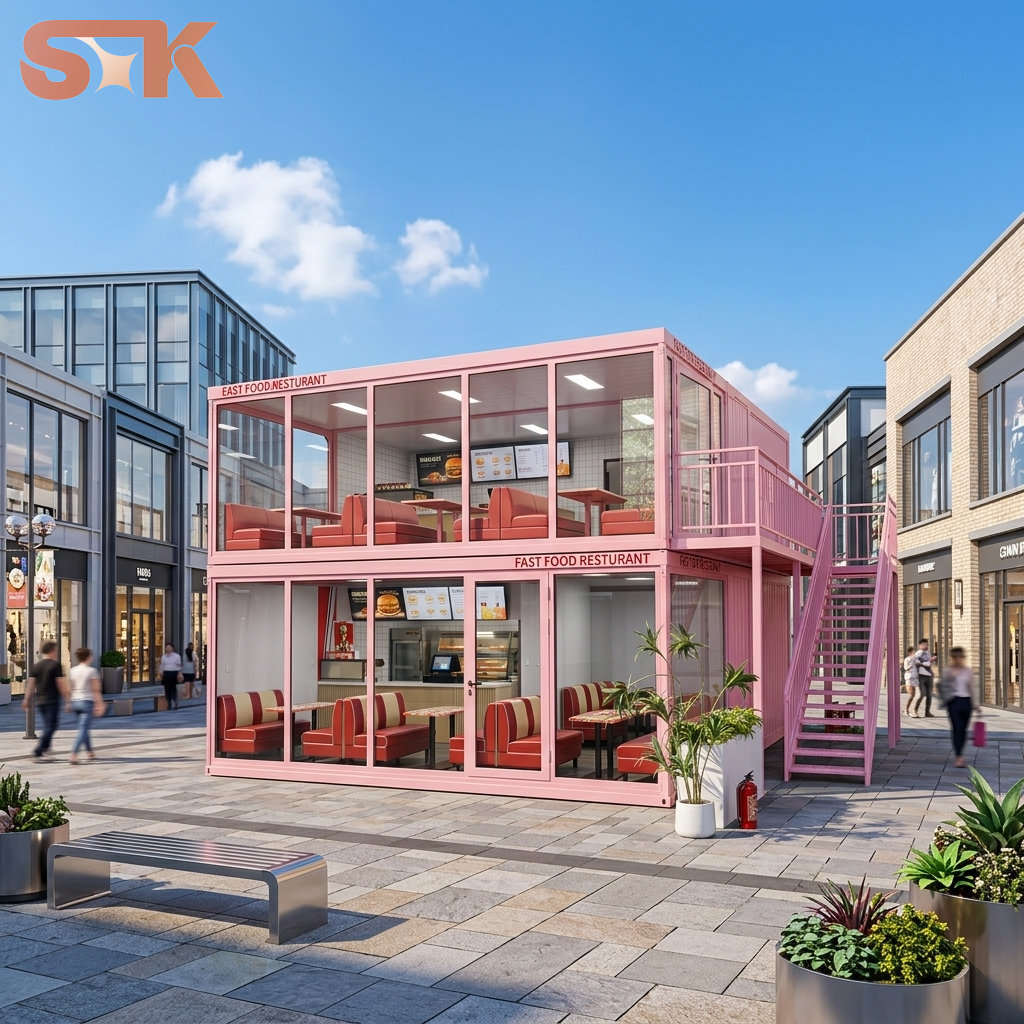
Two-Story Pink Prefab Container Restaurant | Modular Pop-Up Shop for Food Street & Commercial Park
Introduction
Nowadays, modular prefabricated container buildings have become a dominant trending option for global commercial investors, especially the stylish two-story pink glass container restaurant widely applied in internet-famous food streets, scenic campsites, roadside commercial blocks, mini supermarkets and temporary project offices. Unlike traditional brick-and-mortar buildings with long construction cycles and high upfront costs, this customized pink double-deck container shop balances trendy appearance, flexible mobility and diversified co
mmercial functions, gradually turning into the preferred investment solution for pop-up catering and retail businesses worldwide.
Core Advantages of Double-Deck Pink Modular Container Commercial Building
1. Ultra-fast factory prefabrication & on-site installation
All structural frames, interior decoration and glass facades are pre-manufactured in professional factories within 7 to 15 working days. After finished production, the whole container unit is transported to destination sites, and field assembly only takes 2–5 days. Business owners can launch fast-food restaurants, convenience stores or temporary offices in weeks instead of months, greatly shortening construction cycles and cutting early site rental losses. It is perfectly suitable for seasonal food festivals and short-term pop-up retail projects.
2. Viral internet-famous pink outlook with full glass facade
The iconic matte pink outer coating plus full-height panoramic tempered glass wall creates an eye-catching aesthetic ideal for social media check-in. Restaurants and retail stores adopting this pink container design naturally attract foot traffic from Instagram, TikTok and Facebook sharing, significantly lowering offline marketing expenses for food streets and scenic commercial zones. The external open steel staircase on one side meets the second-floor dining area’s evacuation demand while enriching the building’s layered visual effect.
3. Full mobility & repeated reusable modular structure
Assembled by standard modular container units, the two-story commercial building can be disassembled, lifted and relocated to new business locations conveniently. When a food street project expires or merchants need to shift business districts, investors can transport the intact container shop to another campsite or commercial park without abandoning the whole construction. High reusability drastically reduces repeated construction investment compared with fixed brick stores.
4. Wide multi-scene commercial compatibility
A single double-deck pink container unit supports diversified functional layout: the ground floor can be arranged as fast-food service counters, supermarket cashier areas or office receptions, while the upper floor works as customer dining zones, commodity display spaces or independent office rooms. It seamlessly fits fast food diners, mini grocery supermarkets, creative retail boutiques and construction site temporary offices. In addition, lightweight foundation requirements enable installation on lawns, open park lands and vacant roadside plots without large-scale ground hardening engineering.
5. Cost-effective initial investment
Compared with conventional brick-built commercial premises, prefab two-story container shops save 30%–45% of overall construction expenditure on average. Saved costs mainly come from omitted complicated civil engineering, short construction period and reusable main structure, making it a cost-efficient choice for small and medium entrepreneurs stepping into catering and retail industries.
Modular Container Shop vs Traditional Brick-and-Mortar Store | Full Performance Comparison
To help investors make accurate project decisions, we conclude a comprehensive performance comparison between the two-story pink prefab container commercial building and traditional brick shops, covering cost, construction period, service life, operation cost and practical commercial adaptability.
Evaluation Dimension | Two-Story Pink Modular Container Shop | Traditional Brick & Mortar Commercial Shop | Advantage Conclusion |
|---|---|---|---|
Construction & Unit Cost | $120–$160 per sqm (basic model)$180–$280 per sqm (high-end pink glass网红 model) | $250–$400 per sqm | Container buildings save 30%–45% upfront investment; the premium decorative version still has obvious price advantages |
Project Lead Time | 7–15 days factory prefab + 2–5 days on-site installationOpen for business within 20 days | 3–6 months for main construction + 2 months for interior decoration | Container solution supports ultra-fast opening, perfectly for pop-up and seasonal business |
Energy Consumption & Operation Cost | 35% higher air-conditioning consumption for basic steel structure; can be optimized to 15% higher with insulation & Low-E glass | Standard energy consumption (industry baseline) | Traditional buildings are more energy-saving for long-term operation; container upgrades eliminate most energy defects |
Space Utilization Rate | 72%–78% (steel beam & column occupation) | 88%–92% high floor area ratio | Brick shops are better for supermarket shelf layout and compact kitchen design |
Mobility & Reusability | Detachable, movable and reusable; support cross-region relocation and secondary leasing | Fixed permanent building, unable to move; high demolition cost and zero reuse value | Container buildings have exclusive advantages for short-term and multi-site rotating projects |
Appearance & Upgrade Flexibility | Fast exterior color replacement and facade renovation within 3–7 days, suitable for frequent theme updates | Complicated exterior transformation, high cost and long construction cycle | Ideal for internet-famous commercial streets requiring continuous visual renewal |
Service Life | 12–15 years (standard paint); 20+ years (fluorocarbon weather-resistant coating) | 50+ years permanent service life | Brick buildings dominate long-term fixed operation; containers meet temporary commercial needs perfectly |
Fire & Compliance Adaptability | Temporary building standard; requires customized fireproof upgrade for catering business | Fully compliant with permanent commercial fire and construction codes | Suitable for short-term pop-up catering; long-term stores need pre-customized fire protection |
Residual Value | 65%–70% residual value after 3-year use, support resale and secondary renovation | Low residual value, basically no recycling value | Container projects have lower investment risk and better asset preservation |
Existing Limitations & Professional Optimized Solutions
As a steel-based prefab construction, the pink double-deck container shop still has inherent drawbacks of all-steel structures, alongside mature upgrade solutions to fix defects for long-term commercial operation:
1. Temperature fluctuation and high air-conditioning energy consumption
Bare steel frames and large glass panels conduct heat rapidly, leading to higher cooling and heating costs without thermal insulation. Clients can upgrade inner-wall rock wool insulation and Low-E insulated double glazing during factory customization to cut seasonal power consumption by nearly 35%, improving indoor comfort for diners and office staff.
2. Regular exterior anti-rust maintenance for outdoor long-term use
Ordinary pink spray paint fades and peels after 2–3 years of outdoor exposure under sun and rain. Switching to fluorocarbon weather-resistant coating extends the exterior paint service life to over 5 years and reduces annual repainting maintenance cost for coastal or rainy regions.
3. Temporary building property regulation restriction
In most countries and regions, modular container constructions are classified as temporary buildings without formal real estate property certificates. It is more recommended for 1–3 year lease projects such as scenic food stalls and temporary market shops. Investors planning permanent long-run stores shall confirm local municipal construction policies in advance before purchase.
4. Extra fireproof modification for open-flame catering business
Fast-food stores with frying and cooking equipment need additional fireproof rock wool inside walls and automatic sprinkler systems to pass local fire safety inspection. All fire-resistant fittings can be pre-installed in factories to avoid troublesome on-site secondary reconstruction.
Suitable Application Scenarios
Internet-famous themed food streets, glamping park fast food kiosks and roadside catering blocks
Scenic spot temporary convenience stores, mini fresh food supermarkets and campsite retail outlets
Industrial park temporary project offices, construction site management rooms and startup incubation office spaces
Shopping mall seasonal pop-up retail shops, handmade creative commodity boutiques and weekend market stalls
Conclusion
With the booming global pop-up commercial economy and experiential offline consumption demand, the two-story pink glass prefab container restaurant remains a high-potential commercial construction product. For short-term investment projects focusing on quick opening, flexible relocation and online drainage via trendy appearance, modular container shops outperform traditional brick buildings comprehensively. Meanwhile, targeted insulation, coating and fireproof upgrades can eliminate most structural shortcomings, helping investors realize stable long-term operation in catering, retail and office fields.


